merSETA Certification Process for 2026
The Manufacturing, Engineering and Related Services Sector Education and Training Authority (merSETA) has officially outlined its certification process for 2026. This guide seeks to answer common questions regarding the process through which merSETA, together with other statutory bodies, awards nationally recognized certificates to qualified learners, apprentices, employers, and accredited training providers.
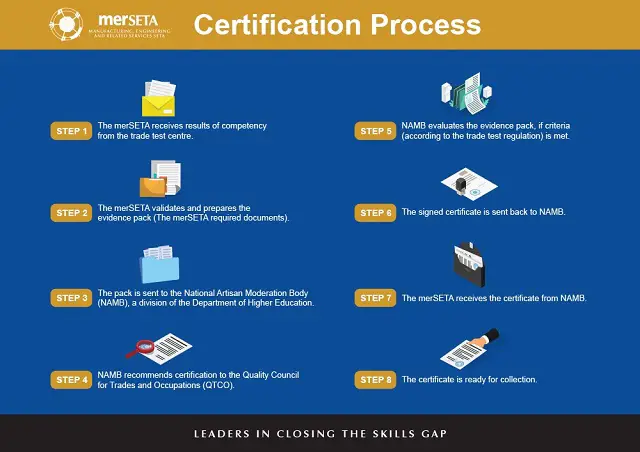
According to official information published by merSETA and related regulatory bodies, the certification process follows a structured governance chain involving merSETA, the National Artisan Moderation Body (NAMB), and the Quality Council for Trades and Occupations (QCTO). Kindly read along as we share the updated merSETA certification process for 2026.
MERSETA CERTIFICATION PROCESS 2026: EVERYTHING YOU NEED TO KNOW
- Step 1: The Decentralized Trade Test Centre (DTTC) conducts the trade test and submits the learner’s competency results to merSETA within five working days after completion of the trade test.
- Step 2: merSETA validates the submitted evidence pack and verifies the learner’s eligibility for certification.
- Step 3: merSETA assigns a unique serial number to eligible apprentices and prepares the required certification documentation.
- Step 4: The evidence pack is forwarded to the National Artisan Moderation Body (NAMB), a division under the Department of Higher Education and Training (DHET).
- Step 5: NAMB evaluates and moderates the evidence pack to ensure compliance with national trade test regulations and quality assurance standards.
- Step 6: After successful moderation, NAMB recommends certification to the Quality Council for Trades and Occupations (QCTO).
- Step 7: The QCTO prints and issues the official trade certificate within 21 working days after receiving the recommendation from NAMB.
- Step 8: The issued certificate is sent from QCTO back to NAMB and then forwarded to merSETA.
- Step 9: merSETA releases the certificate to the accredited training provider or trade test centre for collection by the learner or employer.
UNDERSTANDING THE ROLE OF MERSETA, NAMB, AND QCTO
The merSETA certification process operates under the Skills Development Act 97 of 1998 and involves several statutory bodies responsible for assessment, moderation, and certification.
- merSETA: Acts as the administrative intermediary responsible for validating learner records, checking eligibility, and forwarding evidence packs for moderation.
- NAMB (National Artisan Moderation Body): Moderates trade test outcomes and ensures assessments meet national artisan standards.
- QCTO (Quality Council for Trades and Occupations): Serves as the official national authority responsible for printing and issuing occupational and trade certificates.
MERSETA APPRENTICESHIP AND LEARNER REQUIREMENTS FOR 2026
To qualify for an apprenticeship programme under merSETA, learners are generally expected to meet the following minimum requirements:
- Be at least 16 years old.
- Possess a minimum qualification of Grade 10 or equivalent where applicable.
- Be employed in a relevant trade occupation.
- Be registered with an accredited merSETA training provider and workplace training centre.
The apprenticeship programme combines workplace experience and institutional learning and may run for a maximum duration of up to four years depending on the trade.
MERSETA TRADE TEST APPLICATION PROCESS FOR EMPLOYERS AND TRAINING PROVIDERS
Employers and accredited Skills Development Providers (SDPs) are responsible for initiating trade test applications on behalf of learners who have completed their apprenticeship or occupational training.
Trade test applications may be submitted through the following official channels:
- NSDMS Portal: https://nsdms.merseta.org.za/login.jsf
- Trade Test Application Email: tradetest@merseta.org.za
For Artisan Recognition of Prior Learning (ARPL) applications, employers and providers must use the official merSETA ARPL trade test application forms and provide verifiable workplace evidence where required.
MERSETA CERTIFICATION TIMELINE FOR 2026
| Phase | Description | Processing Duration |
|---|---|---|
| Phase 1 | Trade test results submission from DTTC to merSETA | Within 5 working days |
| Phase 2 | merSETA validation and eligibility verification | Not officially specified |
| Phase 3 | NAMB moderation and recommendation | Not officially specified |
| Phase 4 | QCTO certificate printing and issuance | 21 working days |
| Phase 5 | Certificate distribution and collection | Depends on logistics and collection arrangements |
OFFICIAL MERSETA, NAMB, AND QCTO CONTACT DETAILS
| Entity | Contact Point | Details |
|---|---|---|
| merSETA | Official Website | https://www.merseta.org.za/ |
| merSETA | General Email | info@merseta.org.za |
| merSETA | Call Centre | 086 163 7738 |
| merSETA | Trade Test Applications | tradetest@merseta.org.za |
| NAMB | Official Website | https://nadsc.dhet.gov.za/site/National%20Artisan%20Moderation%20Body |
| NAMB | nadscinfo@dhet.gov.za | |
| NAMB | Telephone | 011 206 1000 |
| QCTO | Official Website | http://www.qcto.org.za/index.html |
| QCTO | Certification Queries | certification@qcto.org.za |
| QCTO | Telephone | 012 003 1800 |
The entire certification process is governed by the Skills Development Act 97 of 1998 and official quality assurance regulations issued by merSETA, NAMB, DHET, and QCTO.
Don’t miss out on current updates, kindly like us on Facebook & follow us on Follow @EAfinder OR leave a comment below for further inquiries.
Related Articles
- List of Universities in South Africa
- List of TVET Colleges in South Africa
- List of Bursaries in South Africa 2026